Description
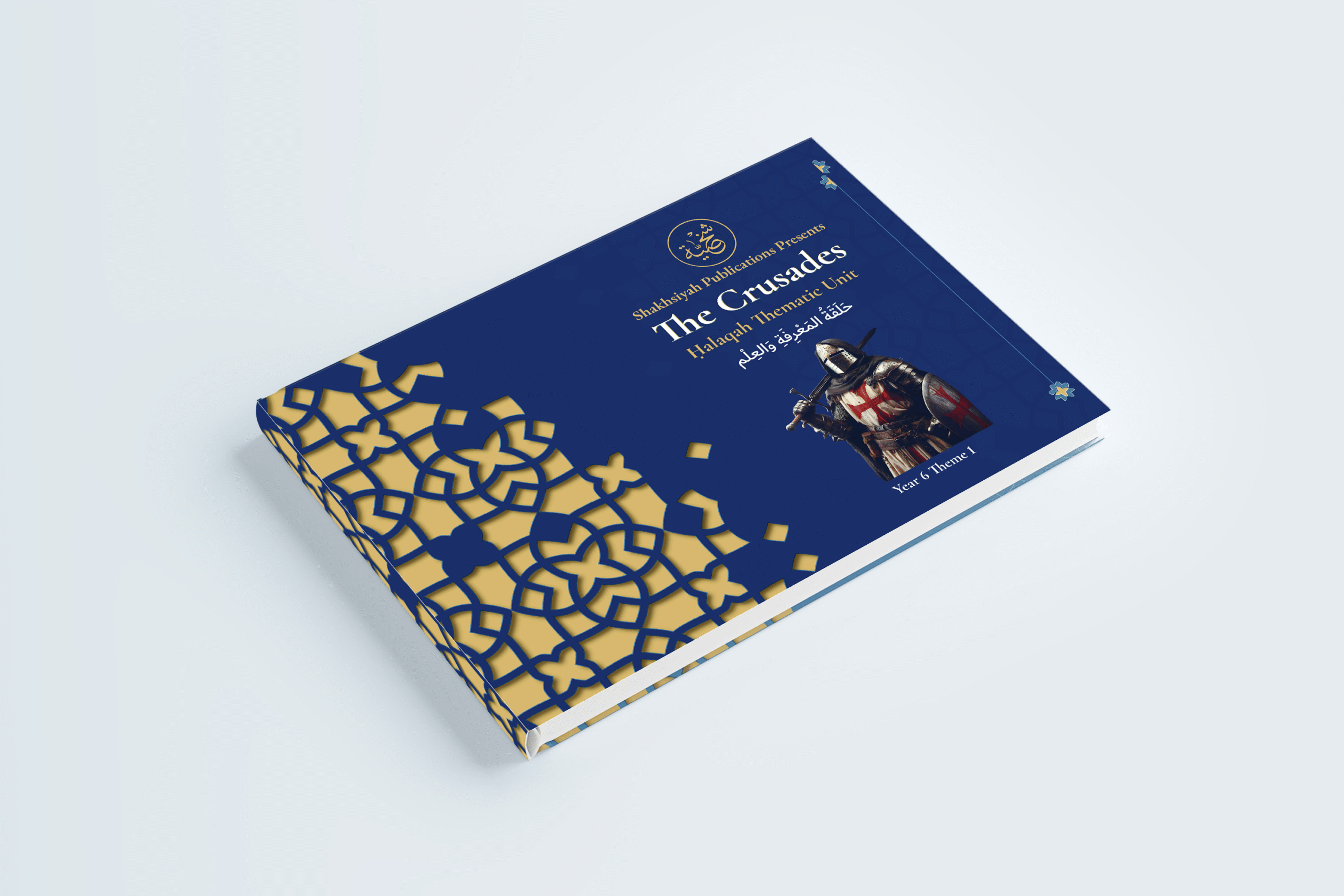
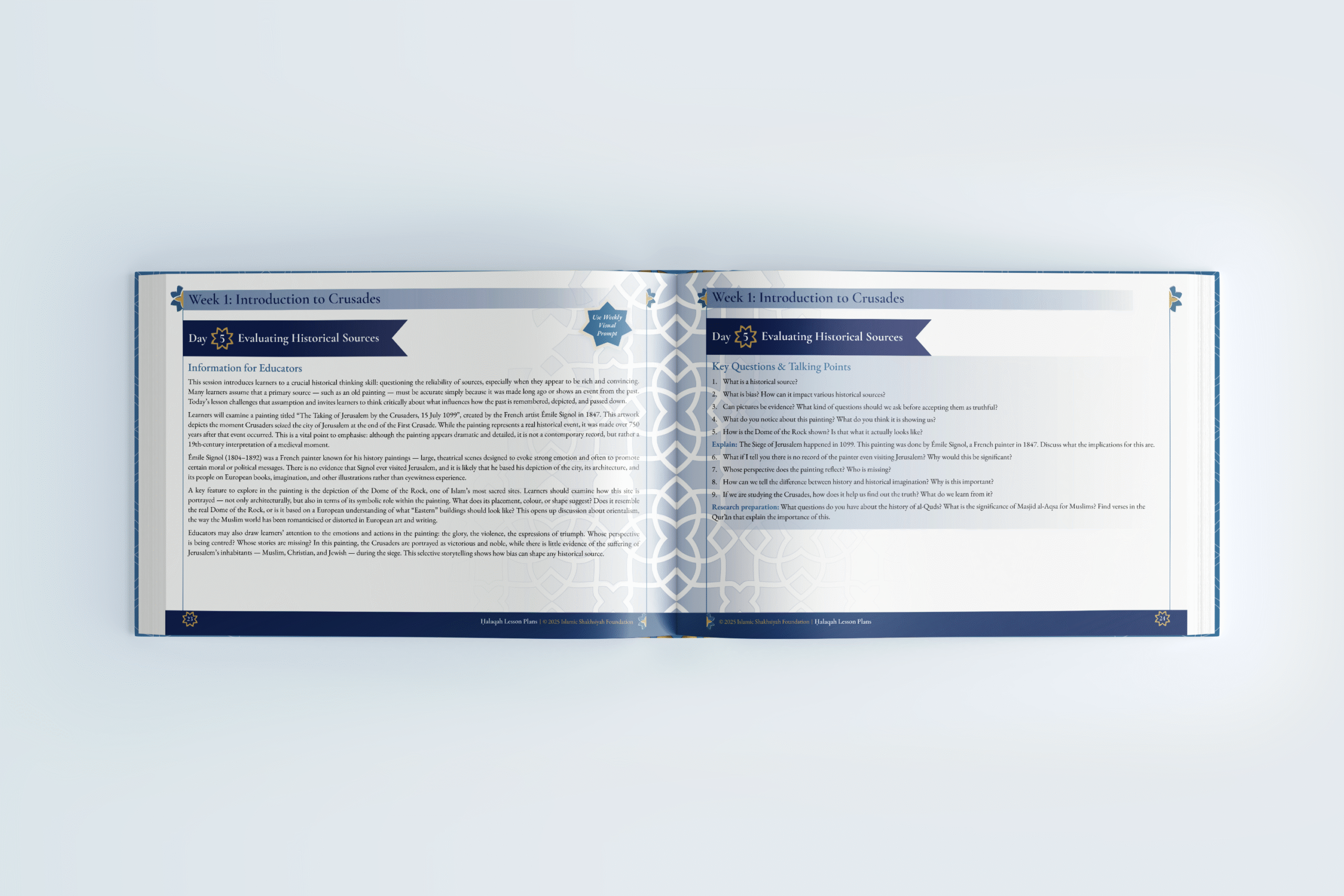
This Year 6 theme, “The Crusades,” intricately examines the multifaceted significance of Jerusalem and Al-Aqsa for Muslims, Jews, and Christians, interweaving historical narratives with religious teachings. It delves into the tales of prophets Ibrahim, Isaac, Yacub, Musa, Dawud, and Suleiman within the context of Jerusalem’s history. Through this analysis, learners explore how our perspectives and beliefs can affect our interpretation of history, that history is not neutral and is written by people who have had biases and various versions of events. Emphasizing Al-Aqsa’s status as the first Qibla for Muslims and Umar bin Al-Khattab’s just rule, it explores the ensuing conflicts in Muslim Jerusalem and the struggles culminating in the Crusades. Learners reflect on leadership dynamics and the ways leadership impacts the outcome of battles, with the ability to change the course of history. Learners also explore the current context of our modern world by reflecting on contemporary issues in Palestine and how the local and global history has impacted and let to the present events; of the importance of the study of the past in order to understand our current contexts Through this exploration, the theme offers profound reflections on historical parallels and their implications for modern realities, drawing from the rich tapestry of religious and historical narratives to illuminate the complexities of the Crusades and their enduring relevance.
Please note: Although each unit is written with a specific age group in mind, all of our units are highly adaptable and can be used effectively across multiple age ranges — right up to adult learners.
How does ḥalaqah work?
- Ḥalaqah is the pedagogy used by Prophet Muhammad (saw).
- During ḥalaqah, the educator and learners sit together on the floor, in a circle facing each other.
- Ḥalaqah begins with Bismillah and Qur’ān recitation and ends with a group duʿā’ which connects to the topic that has been discussed.
- All learners are encouraged to participate. Our ḥalaqah is dialogic – this means that learners engage in extended discussion amongst themselves with educators facilitating the dialogue through key questions and talking points.
- There is always room for direct instruction and storytelling, both of which are important. However, the main objective is to learn through dialogue drawing on the learners’ existing knowledge and building on it.
- Educators are primarily responsible for contextualization of the information in a way that meets the needs of their learners.
Please refer to our Dialogic Ḥalaqah: A Guide for the Muslim Educator on our website for more information about setting up ḥalaqah.
Need help with implementation? Our Dialogic Halaqah courses are carefully designed to support the effective implementation of our curriculum. They equip Islamic educators with the knowledge, confidence, and practical skills to bring dialogic halaqah into their classrooms and to nurture the shakhsiyah Islamiyah (Muslim personhood) of each learner through meaningful, reflective dialogue. Elevate your practice and explore our full range of courses here: https://ielc.learnworlds.com/courses
Reviews
There are no reviews yet.