Description
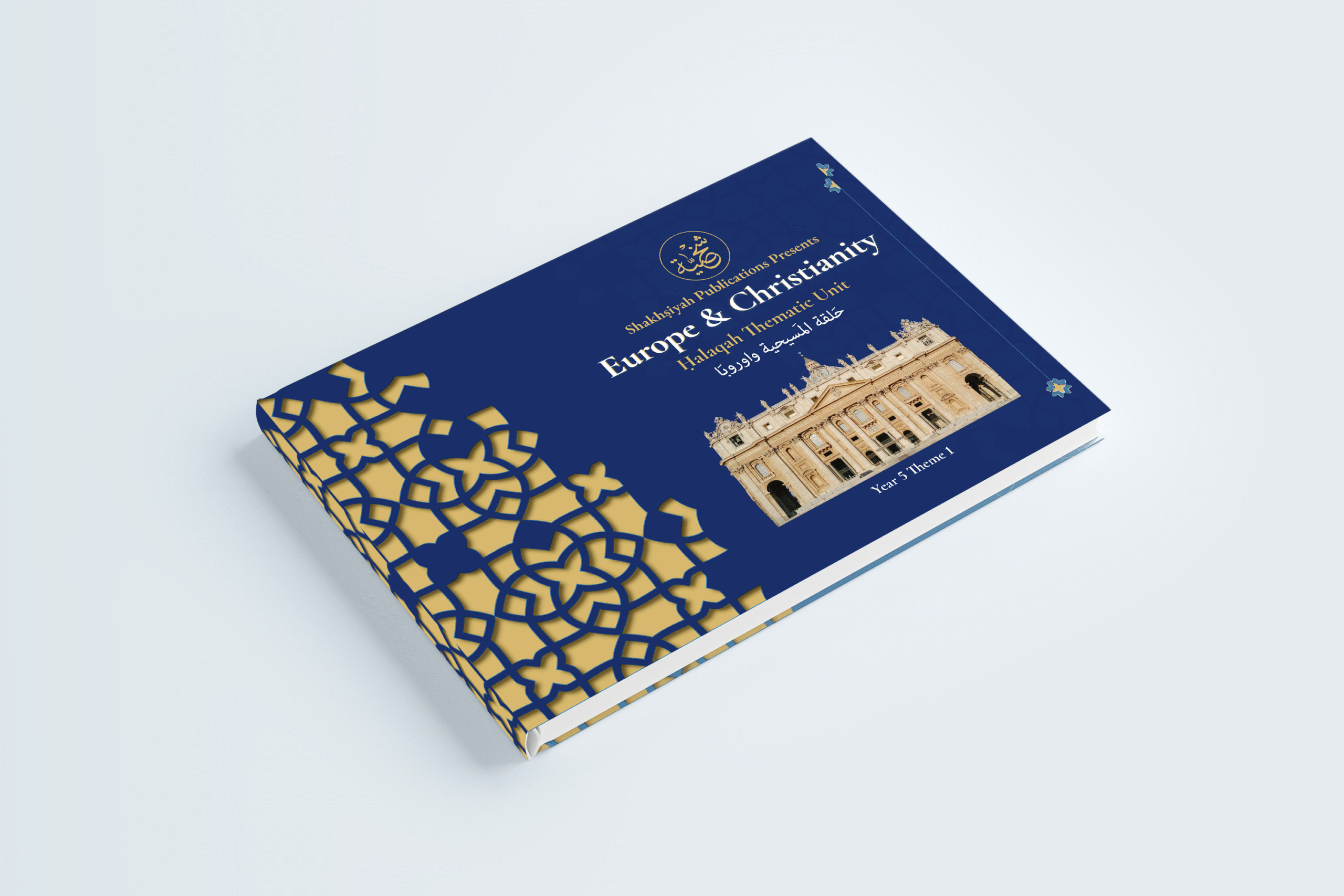
Europe & Christianity is a ḥalaqah thematic unit designed for learners aged 9–10 years but it can also be used with older age groups. This unit supports learners to carry out a historical inquiry exploring the foundations of Christianity, its historical spread across Europe, and its lasting influence on European identity and culture, which is then exported throughout the world through European colonialism. Rooted in a comparative approach, the theme encourages learners to engage critically with Christian beliefs, historical events, and their intersections with Islam. The journey begins with an introduction to Christianity, where learners examine Christian beliefs about God, the Bible, and the role of ʿĪsā (AS). Discussions explore key theological concepts, such as salvation and the Day of Judgement, alongside Qur’ānic perspectives onʿĪsā ibn Maryam as a Prophet and Messenger of Allah (SWT).
Learners then trace Christianity’s spread in Europe, beginning with its early introduction, the role of Constantine, and the development of Christian institutions. They explore key turning points such as the Great Schism of 1054 and the Protestant Reformation, reflecting on how these divisions shaped European history, leading to divergences across the newly emerging European nations. A deep dive into Medieval Europe introduces learners to the social and religious fabric of the time, exploring Christian identity, the Bubonic Plague, and the Hundred Years’ War. This leads into an exploration of different Christian denominations in Modern Europe, where learners consider the role of faith in a society often described as secular, yet deeply influenced by its Christian past. Learners also reflect on the role of holidays in shaping cultural and religious identity, as well as their modern commercialisation. Throughout the unit, learners engage in comparative discussions between Islam and Christianity, exploring shared beliefs, moral principles, and commonalities for example the similarities and divergences in The Lord’s Prayer & Sūrat al-Fātiḥah, and the concepts of being a good Christian or good Muslim.
Please note: Although each unit is written with a specific age group in mind, all of our units are highly adaptable and can be used effectively across multiple age ranges — right up to adult learners.
How does ḥalaqah work?
- Ḥalaqah is the pedagogy used by Prophet Muhammad (saw).
- During ḥalaqah, the educator and learners sit together on the floor, in a circle facing each other.
- Ḥalaqah begins with Bismillah and Qur’ān recitation and ends with a group duʿā’ which connects to the topic that has been discussed.
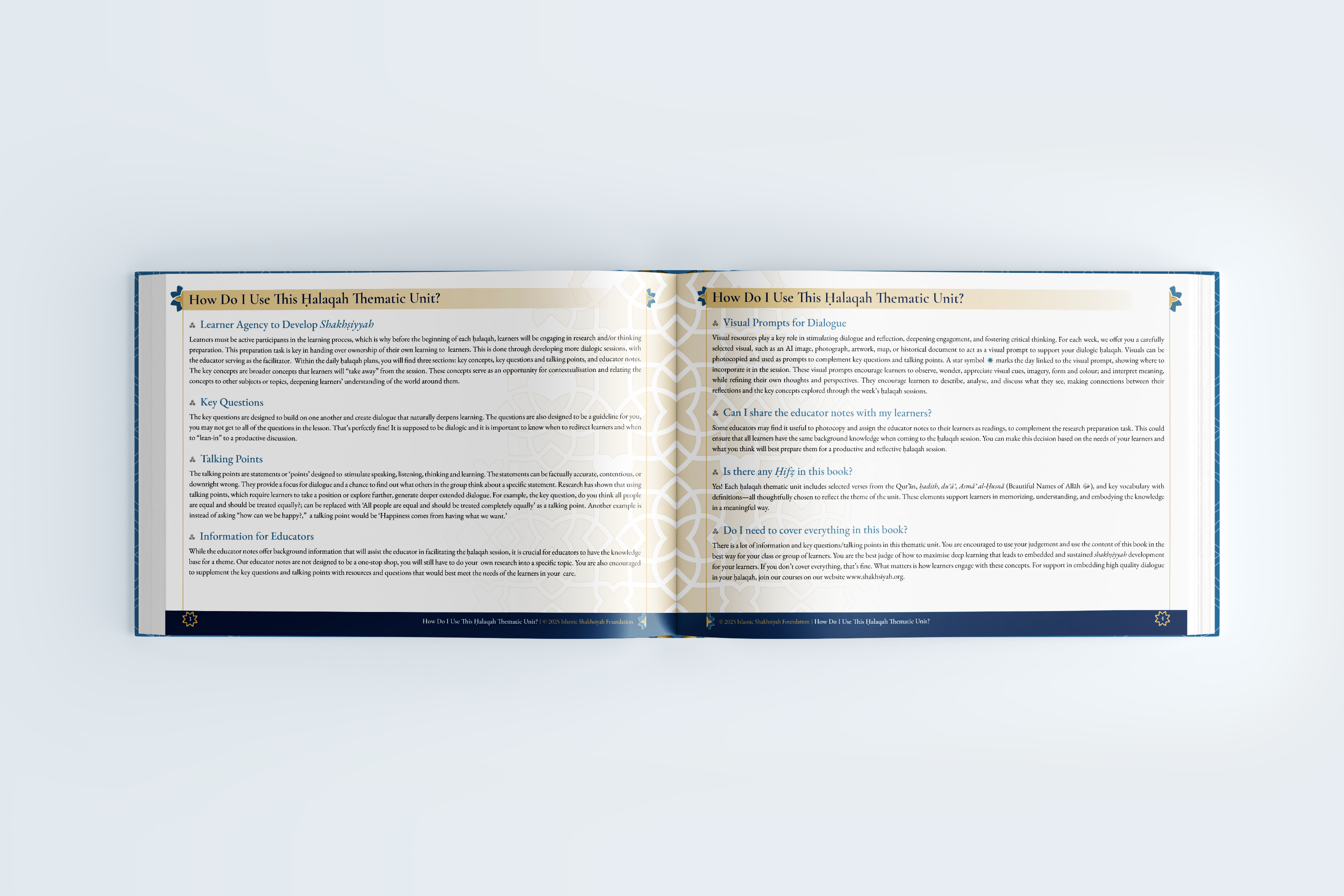
- All learners are encouraged to participate. Our ḥalaqah is dialogic – this means that learners engage in extended discussion amongst themselves with educators facilitating the dialogue through key questions and talking points.
- There is always room for direct instruction and storytelling, both of which are important. However, the main objective is to learn through dialogue drawing on the learners’ existing knowledge and building on it.
- Educators are primarily responsible for contextualization of the information in a way that meets the needs of their learners.
Please refer to our Dialogic Ḥalaqah: A Guide for the Muslim Educator on our website for more information about setting up ḥalaqah.
Need help with implementation? Our Dialogic Halaqah courses are carefully designed to support the effective implementation of our curriculum. They equip Islamic educators with the knowledge, confidence, and practical skills to bring dialogic halaqah into their classrooms and to nurture the shakhsiyah Islamiyah (Muslim personhood) of each learner through meaningful, reflective dialogue. Elevate your practice and explore our full range of courses here: https://ielc.learnworlds.com/courses
Reviews
There are no reviews yet.