Description
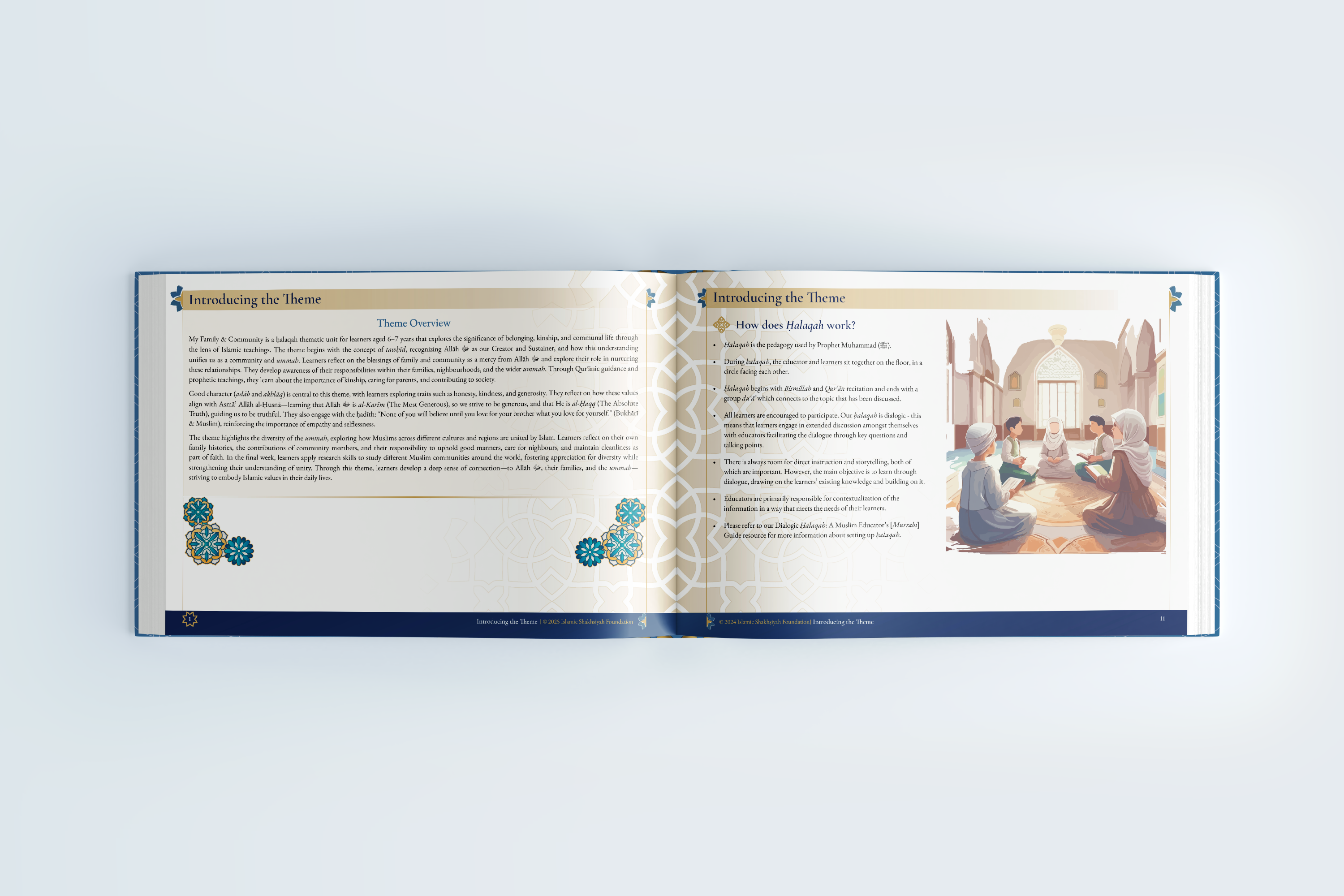
My Family & Community is a ḥalaqah thematic unit for learners aged 6–7 years that explores the significance of belonging, kinship, and communal life through the lens of Islamic teachings. The theme begins with the concept of tawḥīd, recognizing Allāh (swt) as our Creator and Sustainer, and how this understanding unifies us as a community and ummah. Learners reflect on the blessings of family and community as a mercy from Allāh (swt) and explore their role in nurturing these relationships. They develop awareness of their responsibilities within their families, neighbourhoods, and the wider ummah. Through Qurʾānic guidance and prophetic teachings, they learn about the importance of kinship, caring for parents, and contributing to society.
Good character (adab and akhlāq) is central to this theme, with learners exploring traits such as honesty, kindness, and generosity. They reflect on how these values align with Asmā’ Allāh al-Ḥusnā—learning that Allāh (swt) is Al-Karīm (The Most Generous), so we strive to be generous, and that He is Al-Ḥaqq (The Absolute Truth), guiding us to be truthful. They also engage with the ḥadīth: “None of you will believe until you love for your brother what you love for yourself.” (Bukhārī & Muslim), reinforcing the importance of empathy and selflessness.
The theme highlights the diversity of the ummah, exploring how Muslims across different cultures and regions are united by Islam. Learners reflect on their own family histories, the contributions of community members, and their responsibility to uphold good manners, care for neighbours, and maintain cleanliness as part of faith. In the final week, learners apply research skills to study different Muslim communities around the world, fostering appreciation for diversity while strengthening their understanding of unity. Through this theme, learners develop a deep sense of connection—to Allāh (swt), their families, and the ummah—striving to embody Islamic values in their daily lives.
How does ḥalaqah work?
- Ḥalaqah is the pedagogy used by Prophet Muhammad (saw).
- During ḥalaqah, the educator and learners sit together on the floor, in a circle facing each other.
- Ḥalaqah begins with Bismillah and Qur’ān recitation and ends with a group duʿā’ which connects to the topic that has been discussed.
- All learners are encouraged to participate. Our ḥalaqah is dialogic – this means that learners engage in extended discussion amongst themselves with educators facilitating the dialogue through key questions and talking points.
- There is always room for direct instruction and storytelling, both of which are important. However, the main objective is to learn through dialogue drawing on the learners’ existing knowledge and building on it.
- Educators are primarily responsible for contextualization of the information in a way that meets the needs of their learners.
Please refer to our Dialogic Ḥalaqah: A Guide for the Muslim Educator on our website for more information about setting up ḥalaqah.
Need support with implementation? Our Dialogic Halaqah courses are carefully designed to support the effective implementation of our curriculum. They equip Islamic educators with the knowledge, confidence, and practical skills to bring dialogic halaqah into their classrooms and to nurture the shakhsiyah Islamiyah (Muslim personhood) of each learner through meaningful, reflective dialogue. Explore our full range of courses here: https://ielc.learnworlds.com/courses
Reviews
There are no reviews yet.